
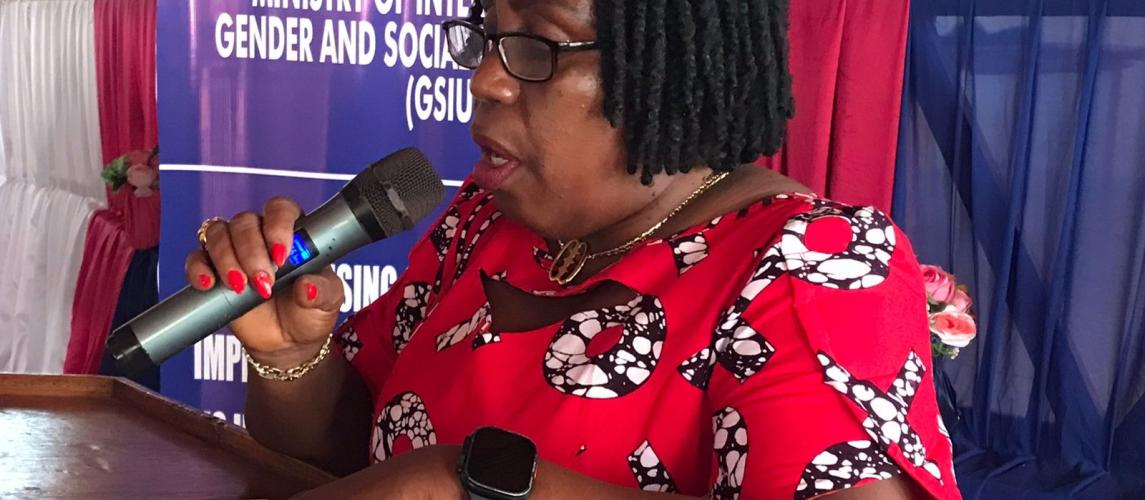
The Ministry of Internal Affairs’ Gender and Social Inclusion Unit (GSIU) Conducts Awareness Workshop on Promoting Transformative Approaches for Integrating Gender Perspectives into Local Development, Tubmanburg, Bomi County.
Remarks by Mrs. Cecelia J. Gould, Director, Gender and Social Inclusion Unit (GSIU), Ministry of Internal Affairs:
Raising Awareness to Promote Transformative Approaches for Incorporating Gender Perspectives in Local Development
Local development across Liberia—particularly in Bomi, Grand Cape Mount, and Gbarpolu Counties—continues to progress as communities strive to strengthen governance, improve service delivery, and enhance livelihoods. Yet a critical gap remains: the meaningful integration of gender perspectives into planning, decision-making, and community development processes. Addressing this gap is essential if development is to be inclusive, equitable, and impactful for all citizens.
Despite the central role women play in agriculture, trade, peacebuilding, family welfare, and community cohesion, their contributions often go undervalued. Traditional norms, unequal access to resources, and limited representation in leadership structures persistently hinder women’s full participation. In many rural areas, women shoulder the bulk of family and community survival responsibilities but have minimal influence over decisions that directly affect their lives. This imbalance weakens local governance and limits development outcomes across the counties.
This workshop has therefore been organized to raise awareness and promote transformative approaches that encourage the incorporation of gender perspectives into local development processes. The aim extends beyond increasing knowledge; it seeks to empower participants—especially traditional women, community leaders, and local authorities—to understand the importance of gender-responsive development and apply it in practical, community-oriented ways.
Gender equality is not an abstract concept—it is a development imperative supported by national policies, regional goals, and international frameworks. Liberia’s National Gender Policy, the GBV Roadmap, the Local Governance Act (2018), and other frameworks all call for gender mainstreaming in planning and service delivery. However, achieving these policy objectives at the county, district, and community levels requires intentional action, capacity-building, and shared ownership among local actors.
In Bomi, Grand Cape Mount, and Gbarpolu, the involvement of traditional women—including market leaders, community mobilizers, peace hut members, and women within traditional councils—is especially important. These women play major roles in shaping norms, resolving disputes, and supporting families, yet often lack the visibility, recognition, and training needed to influence formal governance processes. Enhancing their awareness and leadership capacity will help ensure that community decisions reflect the priorities and lived realities of all citizens.
This workshop will:
Introduce participants to key gender concepts, including gender roles, stereotypes, and power dynamics
Explore how gender inequality affects development outcomes—health, education, economic progress, and community stability
Examine harmful traditional practices and GBV, and discuss community-level strategies for prevention and response
Strengthen participants’ understanding of women’s rights, legal protections, and national gender policy frameworks
Build practical skills in gender mainstreaming—integrating gender analysis into planning, budgeting, community dialogues, and development initiatives
Promote leadership, confidence-building, and collective action among women
Strengthen collaboration among women leaders, County Gender Officers, traditional authorities, youth groups, CSOs, and county governance structures
Using a participatory approach that encourages experience-sharing and open dialogue, the workshop will help participants reflect on how gender norms shape everyday decisions and community development. It also provides space for discussing cultural sensitivities and traditional beliefs, recognizing that sustainable change must be grounded in community realities and driven by local solutions.
Ultimately, the workshop aims to inspire participants to adopt transformative approaches—approaches that challenge discriminatory practices, encourage men and boys as allies, and create environments where women can speak freely, lead confidently, and participate fully. Transformative gender work goes beyond increasing women’s presence; it focuses on shifting mindsets, strengthening systems, and correcting structural inequalities.
By the end of the workshop, participants will have a clearer understanding of gender-responsive local development and how it can be achieved in Bomi, Grand Cape Mount, and Gbarpolu. They will leave with practical tools, strategies, and action plans to guide community engagement and advocacy, and to support collaboration with local authorities. More importantly, they will be empowered to serve as agents of change—fostering inclusion, equality, and sustainable development within their communities.
This workshop marks an important step toward building local development processes that are more inclusive, participatory, and responsive to the needs and aspirations of all citizens—especially women. It sets the groundwork for stronger, more resilient communities where gender equality is recognized not only as a human right, but as a driver of peace, progress, and shared prosperity.
